
.png)
For most of branding history, scarcity was a natural differentiator. Producing a campaign, building a visual identity or launching a content programme required time, budget and skilled people. Those constraints forced brands to think carefully. You could not afford to be careless.
That friction is gone. Content that once took weeks to develop can now be generated in minutes. The result is an environment where everyone is publishing, producing and distributing at the same pace.
Visibility has become easy. Distinctiveness has become hard.
And in that environment, taste has quietly become the most important strategic asset a brand can have.

What Taste Actually Means for a Brand
Taste is not aesthetics. It is not having a considered colour palette or a font that feels considered. Those are outputs.
Taste is the judgment that produces those outputs. It is the ability to look at an infinite set of options and decide what your brand should and should not do, and then hold that position even when it is commercially inconvenient.
It lives in restraint. In knowing which collaborations to turn down. Which trends to ignore. Which versions of yourselves to not become.
When anyone can make anything, the differentiator is not what you can produce. It is what you choose to produce and why.
This is where most brands slip. In an environment of infinite possibility, the default move is expansion, more content, more formats, more partnerships, more presence. But more is not a point of view. Volume is not taste.

The Problem AI Has Actually Created
AI has made the first layer of creativity—knowledge, production, output—nearly frictionless. You can generate ideas, copy, campaign concepts and visual directions faster than ever. What AI cannot do is tell you which of those ideas is worth backing.
That is a conviction problem. And conviction cannot be automated.
AI systems are, at their core, optimisation engines. They are trained to produce what is most likely to be correct, coherent or commercially legible. That logic produces competent output. It rarely produces distinctive output.
The brands that stand out have always been the ones willing to make a bet that looked wrong before it looked right. A24 backing unconventional films nobody thought would travel. A luxury brand casting someone who broke every expectation of the house. A retailer staying small when growth was available because scale would have diluted the very thing that made them worth choosing.
These are not AI decisions. They are human ones, made with conviction, experience and a clear sense of what the brand is trying to be.

Taste as a Filter, Not Just a Feature
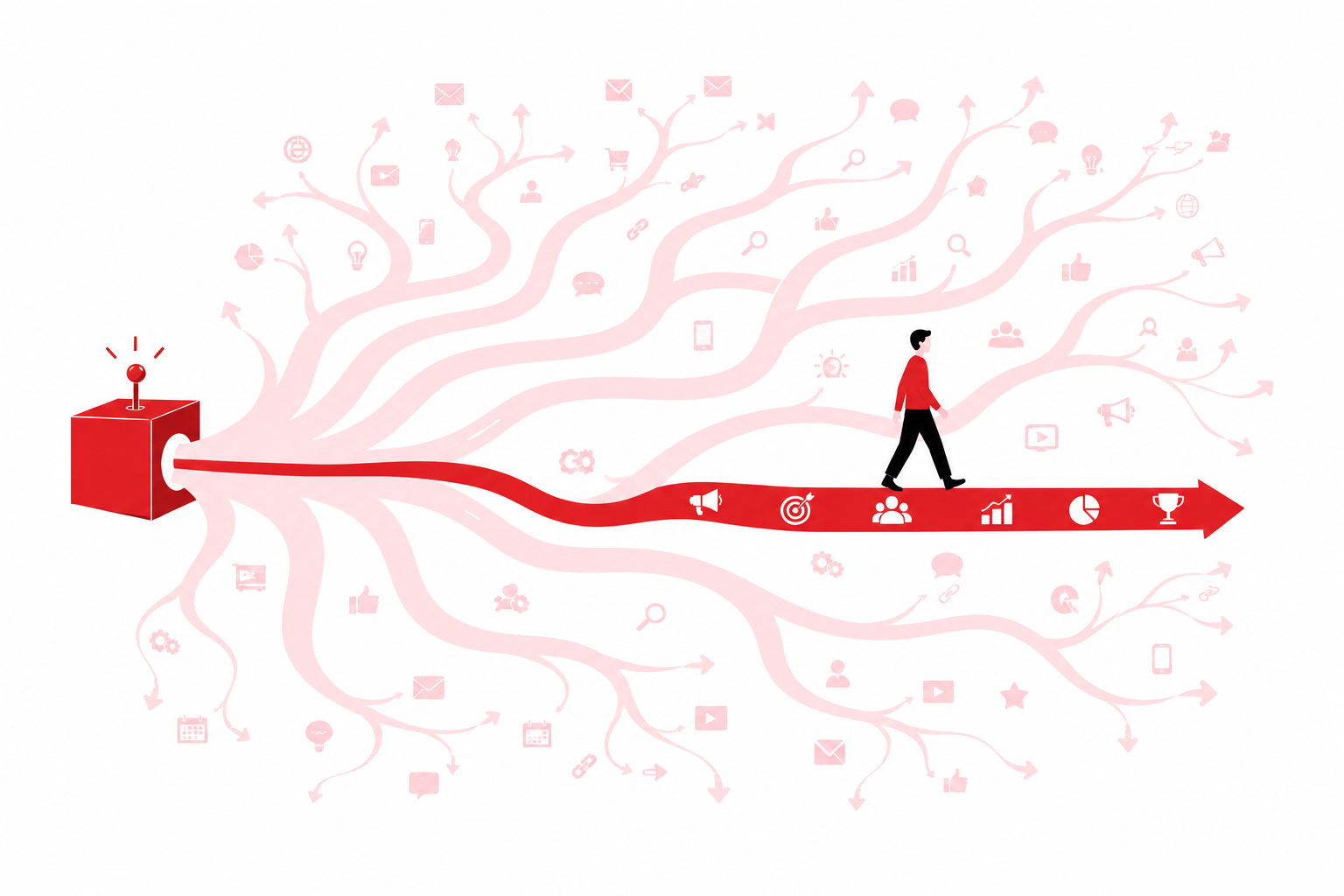
One way to think about taste in brand strategy is as a filter. Not a creative mood board—a decision-making framework.
Brands with strong taste know what to say no to. They do not chase every cultural moment. They do not repurpose every format. They do not collaborate just because the audience overlaps. They evaluate everything through the lens of what they actually stand for, and they are willing to leave opportunity on the table to protect that integrity.
This kind of restraint is increasingly rare. And because it is rare, it is increasingly visible.
Discernment, in an age of abundance, is itself a signal. It tells audiences that you know who you are, and that you are not for everyone.
That is not exclusivity for its own sake. It is the natural outcome of a brand with a real point of view.
Building Taste Into the Work
Taste is not innate. It is built through exposure, through rigorous study of references, through asking why something works rather than just noting that it does. For brands, that means developing real cultural literacy, understanding the history and context behind creative choices, not just the surface appearance of them.
It also means hiring for it. The people making decisions about what a brand says, looks like and stands next to, need the depth of reference and the confidence to use it. That is not a brief that AI tools can fill.
It is a capability that has to exist in the team itself.
And critically, it means building systems that protect judgment, where commercial pressure does not automatically override creative conviction, and where the question is not just "will this work?" but "does this belong to us?"
In an environment where AI can produce anything, the brands that earn attention will not be the ones who produce the most.
They will be the ones with the taste to produce the right things, and the conviction to mean it.
.png)